Birth Certificate in UP — Apply Online on eSathi
What is a birth certificate?
A birth certificate (जन्म प्रमाण पत्र, janm praman patra) is the first legal identity document of a child — the official record of the child's name (when given), date and place of birth, and the parents' names. In Uttar Pradesh, births are registered with the local registrar of births and deaths — the municipal body in towns and the designated registrar for rural areas — and the certificate is issued from that registration record.
This single document is demanded throughout life:
- School admission — the standard proof of age for first admission.
- Aadhaar, passport and later IDs — date-of-birth proof in almost every identity process starts here.
- Government schemes for children — benefits and enrolments for minors use the birth record.
- Age proof in jobs and law — where date of birth must be proven rather than merely declared.
Uttar Pradesh handles birth certificate services through the same eDistrict/eSathi system as its other certificates, alongside the registrar's own record. The sections below separate the three situations parents actually face — a new birth, a delayed registration, and a correction — because the process is different in each.
Birth certificate at a glance
| Register the birth within | 21 days of the birth |
|---|---|
| Fee via eSathi (self-apply) | ₹10–15 |
| Fee via CSC | ₹30 + ₹30–50 facilitation charge |
| Processing time (online route) | 7–15 working days |
| Validity | Permanent — never expires |
| Late registration beyond 1 year | Requires SDM (magistrate) order |
| Where to apply | esathi.up.gov.in and the local registrar of births & deaths |
| Helpline | 0522-2304706 · ceghelpdesk@gmail.com |
The 21-day rule and late registration
Indian law expects every birth to be reported to the registrar within 21 days. Within this window, registration is straightforward: the event is fresh, the hospital report or the family's report is accepted at face value, and no one asks awkward questions.
Once the window passes, the route changes by how late you are:
- 21 days to 30 days — registration is still done by the registrar, on payment of a small late fee.
- 30 days to 1 year — registration needs written permission from the prescribed authority, along with the late fee and supporting proof of the birth.
- After 1 year — the birth can be registered only under an order of the Sub-Divisional Magistrate (SDM). You apply to the SDM with an affidavit and the best proof available — hospital records, the mother's discharge papers, school records if the child is older, parents' Aadhaar. The magistrate's office enquires into the claim, and on the order being passed, the registrar enters the birth and the certificate is issued.
Hospital births and home births — what differs
Birth in a hospital or nursing home
The institution is responsible for reporting the birth to the registrar — it sends the birth report from its own records. The parents' job is follow-up: give the names and details exactly as they should appear (spellings matter for life), collect the discharge summary, and obtain the certificate once registered. Check every spelling on the report before leaving the hospital; correcting a name afterwards is slower than checking it on day one.
Birth at home
For a home birth, the family itself reports the birth — the head of the household informs the local registrar within 21 days, and the registration is supported by the self-declaration and local verification where required. Home births are precisely the ones that get missed, so treat the 21-day clock seriously; if the period has already passed, use the late registration route described above.
Documents required for a birth certificate
- Birth report or discharge summary from the hospital (for institutional births)
- Aadhaar card of the mother
- Aadhaar card of the father
- Self-declaration form, filled and signed, where asked — upload as JPEG
- Address proof of the parents (ration card or Aadhaar with current address)
- For late registration: affidavit, any proof of the birth (hospital or school records), and the SDM's order where required
How to apply for a birth certificate online — step by step
Confirm the registration has been initiated
For a hospital birth, confirm the institution has sent the birth report to the registrar. For a home birth, report the birth to the local registrar within 21 days. The online certificate process builds on this registration record.
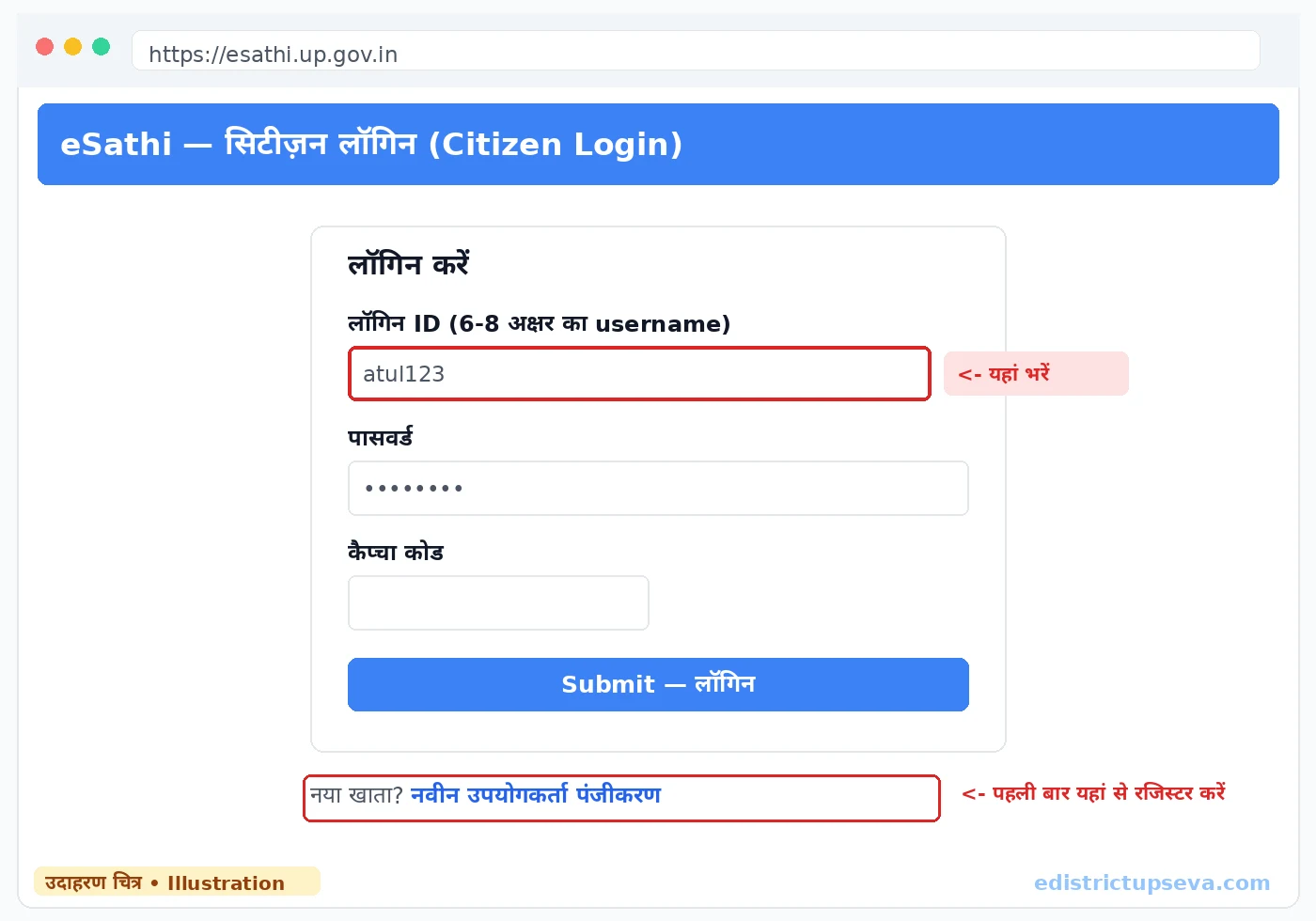
Register or log in on eSathi
Open esathi.up.gov.in. New users register via "New User Registration" (नवीन उपयोगकर्ता पंजीकरण) with name as on Aadhaar, date of birth, address, district, Aadhaar-linked mobile and a 6–8 character login ID, verify the Aadhaar OTP, and set a password after the first login. Parents apply from their own account for the child's certificate.
Select the birth certificate service
From the dashboard's certificate services, choose the birth certificate (जन्म प्रमाण पत्र) service. If your case is a delayed registration, first complete the permission or SDM order step described above — the online application proceeds on the basis of that order.
Enter the child's details
Fill in the date of birth, time and place of birth, gender, and the child's name if it has been decided — registration is allowed without a name, which can be added later. Enter the spellings exactly as you want them to appear permanently; this record follows the child for life.
Enter both parents' details
Fill the mother's and father's names exactly as on their Aadhaar cards, along with their Aadhaar numbers and the family's permanent and current address. Mismatches with Aadhaar are the most common cause of queries in birth applications.
Upload the documents
Upload the hospital birth report or discharge summary, both parents' Aadhaar cards, and the self-declaration as JPEG — every file under 100KB and clearly readable.
Review every spelling, then submit
Read the preview slowly, character by character: child's name, parents' names, date of birth. A spelling error caught here costs nothing; the same error caught after issue means a formal correction process.
Pay the fee
Pay the ₹10–15 fee through PAYGOV (UPI, net banking or debit card). If the amount debits but the status shows pending, wait 24–48 hours for reconciliation rather than paying again.
Save the SRN
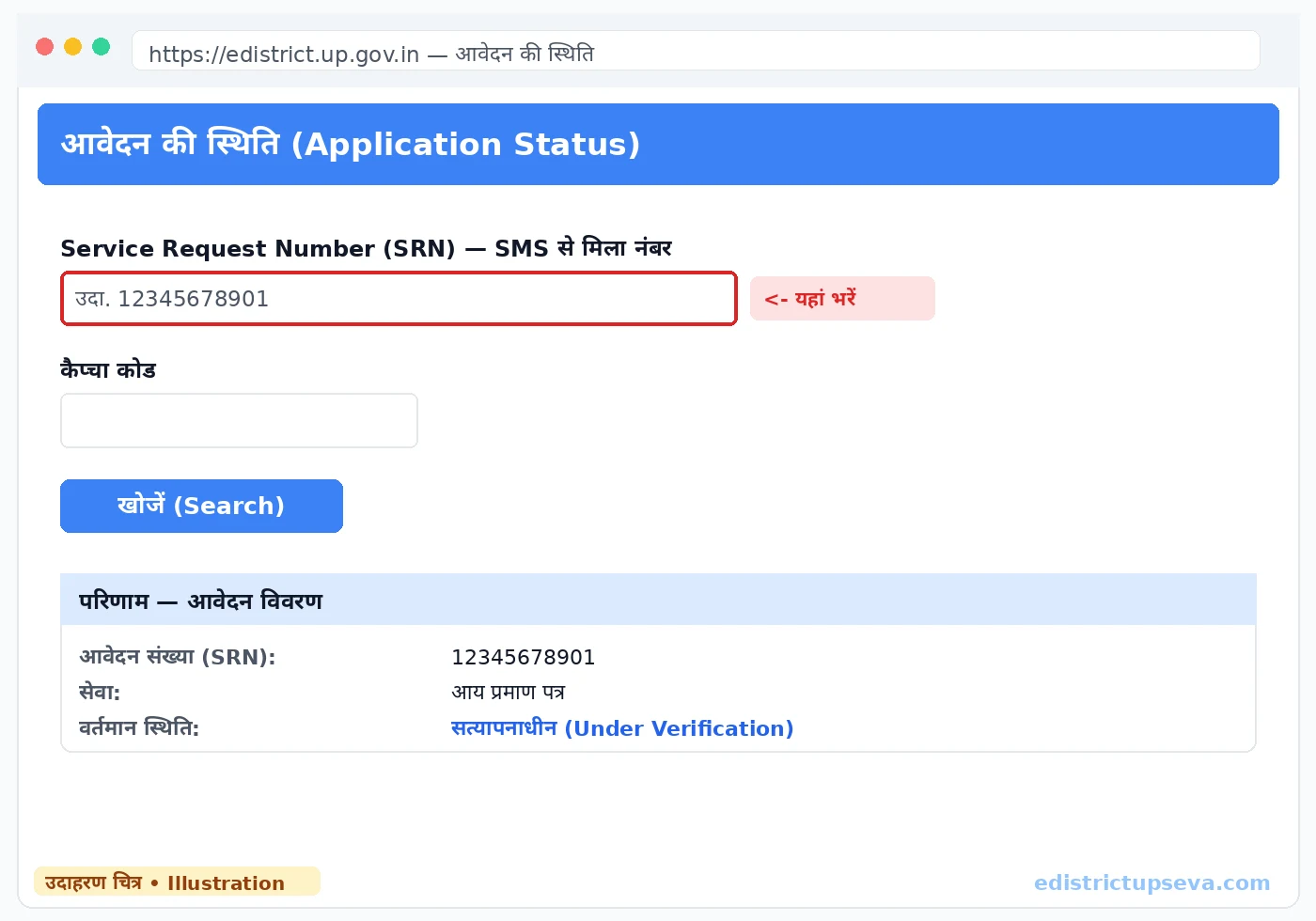
Note the Service Request Number (SRN) shown on screen and sent by SMS — you will use it to track the application and for any enquiry with the registrar or helpline.
Name and date corrections on a birth certificate
Corrections fall into three levels of difficulty:
- Adding a name — if the birth was registered without the child's name, the name can be entered later through the registrar on the parents' application. This is a routine, expected process.
- Spelling corrections — a wrong letter in a name is corrected by the registrar on the strength of supporting documents: the hospital record, parents' Aadhaar, and school records where the correct spelling is in use.
- Date of birth changes — the hardest. The registered date is treated as strong legal evidence, so a change demands solid proof such as the original hospital record and, in contested cases, an order of the competent authority. Expect scrutiny, and expect it to take time.
The lesson is plain: most correction work exists because nobody checked the hospital report on the first day. Whatever stage you are at, begin a correction with documents in hand rather than explanations.
Fees: applying yourself vs through a CSC
| Route | Government fee | Extra charges | Total you should pay |
|---|---|---|---|
| eSathi (self-apply online) | ₹10–15 | None | ₹10–15 |
| CSC / Jan Seva Kendra | ₹30 | ₹30–50 facilitation | ₹60–80 |
Late registration can add a small statutory late fee, and the SDM-order route involves affidavit costs of your own — but the certificate charges above remain the official ones. See the CSC guide before paying anyone more.
Check status and download the certificate
Track the application with your SRN — the method and the meaning of each status are explained in the status check section of the homepage guide. When the status shows Certificate Generated, download from eSathi: Completed Applications → your application → Print → Save as PDF. Print copies as needed from that signed PDF, and back it up digitally — this is a permanent record. It also appears in DigiLocker's Issued Documents after a few days.
Common rejection reasons — and how to fix them
- Birth not traceable in the register — the hospital report never reached the registrar, or a home birth was never reported. Complete the registration first (late route if needed), then apply.
- Parents' names mismatch Aadhaar — align the spellings with the Aadhaar cards and resubmit.
- Late application filed as a normal one — a birth older than a year filed without the SDM order is returned. Obtain the order, then apply.
- Self-declaration missing or uploaded as PDF — sign it and upload a clear JPEG under 100KB.
- Details differ from the hospital report — date, place or parents' names that do not match the discharge record trigger queries. Copy details from the report exactly.
Rejection carries no penalty: read the remark in eSathi, correct the specific point and resubmit. For help, call the helpline at 0522-2304706 or write to ceghelpdesk@gmail.com with your SRN.
Related guides
- Death Certificate in UP — registration of deaths, documents and the online process.
- Parivar Register Nakal — the family register copy used in many family-record matters.
- Self-Declaration Form — format and upload rules for the signed declaration.
- Domicile Certificate in UP — permanent residence proof for admissions and state jobs.
Frequently Asked Questions
Within how many days should a birth be registered in UP?
How much does a birth certificate cost in UP?
How long is a birth certificate valid?
What if the birth was never registered and the child is now older?
Can I correct a wrong name or date on a birth certificate?
Is the child's name compulsory at registration?
What documents are needed for a hospital birth?
How many days does a birth certificate take through eSathi?
Last updated: 22 October 2026